

Archive for the ‘Project Management’ Category


The Distracted Programmer

On Friday I jokingly posted on twitter that I was going to write my #iDevBlogADay post on “How to code with a baby in your arms”. A whole bunch of people responded saying they’d love to see a post on “The Distracted Programmer”, so here I sit typing.

With a baby born over five weeks ago, I took several weeks off work entirely. But about two weeks ago I started trying to get back into doing little bits of work. Working from home with a baby in the house is proving to be quite difficult, but I’ve already learned a few things that are helping me get at least some work done. Just keep in mind, I’m still new to this. I don’t pretend to have all the answers, just some tips that work for me.

1) Start Small

When I first decided to start coding again, I set a goal of writing one hour of code per day. The first few days I failed miserably. I’m glad I hadn’t decided to work full days or I might have been very discouraged. However, after a few days I found I was able to get even up to two hours of work done, just in 20 minute increments. My main point here is don’t expect too much from yourself at first. Getting used to having a baby is a huge change, trying to work at the same time is a massive challenge. Accept that it’s going to be hard and don’t beat yourself up if you’re not working full days right away.

2) Learn to Work in Small Increments

If you haven’t read this excellent article called “The Interruptable Programmer“, do so now. All of his tips apply to working at home with a baby in the house. I’ll wait. Done? Good. The biggest take-away there is that you need to get used to working in small chunks. Always be aware of what you’re working on. Make notes about what needs to happen next. If you need to stop coding because the baby starts screaming, jot down something quick about what you were doing; put it right in the code if you have to. Personally, I bought a little Mac app called ShoveBox that allows you to take very quick notes just by pressing a key combination on your keyboard.

If you’re a programmer who likes to really dig deep into code and do marathon coding sessions (like I used to), this is going to be a huge adjustment, but it’s a necessary one. If the choice is between coding 30 minutes at a time and not coding at all, I’m going to try to code 30 minutes at a time.

3) Staying Motivated

One of the most difficult things for me over the last couple of weeks has been staying motivated when I can only code in short bursts. It’s easy to get side tracked. It’s really easy to get distracted with reading blogs posts [cough] after each break in coding. This will kill your time. You need to find ways to keep motivated and keep working. I’ve completely stopped reading RSS feeds during the last two weeks. It means I’m not as aware of what’s going on in the world of gaming, but I’ve got a contract to deliver on, so that takes priority. I try to limit my time on twitter when I’m starting a work chunk. I limit what links I click on to avoid being distracted.

The goal is to get right back in where you left off after you’ve been away from the computer for a chunk of time. This will help you stay motivated. Avoid the distractions, and you’ll find a new flow.

4) Talk to Your Partner

This is the most important point. Seriously. Make sure you do this.

If you’re a single parent, you’re amazing. I honestly don’t know how people do it on their own. A baby is a huge amount of work, even spread over two people. Single parents, I’m in awe of you.

But, if you’ve got a partner who is also at home (on maternity or paternity leave, or as a stay-at-home mom or dad), talk to them. Make sure they’re on board with you going back to work. You will need their support. You will need them to look after the baby while you’re at work. You will need them to understand that you’re going to need some time to code/design/draw/create. At the same time, make sure they understand that you’re not disappearing. If the baby won’t stop screaming and they need a break, let them know it’s OK to interrupt you and ask you for help. But also make sure they’re OK with you shouldering them with more responsibility while you’re working. As the baby gets older, and you establish more of a routine, hopefully you’ll be able to spend more time working each day.

Having an amazing wife who understands all of this has made it much easier to get back to working. I’m still only working half-days, but without her support I wouldn’t be doing even that.

5) Working With the Baby

There are times when I need to look after the baby and do work. If (and this is a big if) the baby is in the right mood, sometimes he’ll let me put him into a baby carrier and he’ll happily sleep while I sit and do some coding. It doesn’t always work, and it’s not ideal, but it is a way to look after the baby and do some work at the same time.

6) Family Comes First

Yes, I’m talking about working with a baby in the home, but the final thing I wanted to say is to remember that your baby and your family come first. If your partner needs you, be there for them. If the baby needs you, look after him/her. Yes, we need to get work done, but work isn’t everything.

Conclusion

Working at home with a baby in the house is possible, but it is very challenging. The thing I keep reminding myself is that it’s an amazing opportunity most people don’t get. Most people don’t get to go back to work yet still see their child grow up before their eyes. We’re very lucky that we get to do this. Don’t take it for granted. Enjoy it.

What about you? As a mom or dad programmer/designer/artist/creator, what are your tips for working from home?

Owen


LandFormer Postmortem

A couple of months after I launch a game, I like to sit down and take a hard and honest look at the things that went right and the things that went wrong: a postmortem. It’s a great exercise to go through after a game is launched to learn from your successes and, more importantly, your mistakes. I wrote up a postmortem after launching Monkeys in Space that was based on the structure that Game Developer Magazine uses. I’m going to use that same format for this LandFormer postmortem.

Introduction

If you haven’t played the game, LandFormer is a puzzle game for iPhone/iPod touch. Each level is made up of a 5×5 grid of terrain at different heights (oceans, up to mountains). The goal on each level is to use land forming tools to modify the heights of the terrain tiles to flatten things out. It’s a challenging game that starts off very easy, but get quite difficult in the harder levels. It’s a game that requires skill, patience, but most of all, intuition.

The game is free to download and try (there are 12 levels currently in the free version of the game), with In-App Purchase (IAP) available to upgrade to the “full” version of the game, as well as IAP for additional visual themes and additional levels. I think of it like a demo, where the user gets to try it and then decide if they want to spend money on more levels. The free version also contains ads, which are disabled if the player buys any content from the in-game shop.

The game launched on June 29, 2010 and has had 147,000 downloads of the free version of the game so far.

What Went Right?

1) Gameplay

I’m really happy with how the game itself turned out. LandFormer started as a prototype called “UpDown” that I did in 6 hours at the all-night GameJam for 360iDev Denver in September, 2009 (I participated via Skype). After I launched Monkeys in Space, I returned to the prototype in early 2010 and started playing around with ways to make it more fun, and settled on the terraforming theme, which helps players understand what they’re supposed to do, and why.

What I like most about the game is that I haven’t really seen other puzzle games like it. It’s similar in play-style to sliding block puzzle games (it requires a similar combination of spatial reasoning and intuition), but the up/down movement of the pieces makes it feel very new and requires new ways of thinking. It’s also very easy to learn how to play, but takes time to really master it and get good at the more difficult puzzles. In the end, I think the gameplay stands as being strong, and I’m very pleased with how the game turned out.

2) Strong Launch

This is my 3rd game, and thus my 3rd game launch. However, with LandFormer I decided it was time to try a new launch strategy. With my previous games, I launched the games as soon as Apple approved them. This caused all sorts of problems in terms of getting press materials out, and reviews trickling out gradually. With LandFormer, I decided to set a proper release date. When Apple approved the game, I set the release date for a week and a half into the future. I immediately sent out press releases to sites along with promo codes (yes, they work once the game has been approved, but before it’s available in the store) for press to try the game. Because my content is all IAP on my server, I could also make it available to the press for free during the pre-launch review period. Very handy.

The result of this new launch strategy was that several large review sites had reviews out within one or two days of launch. This helped pick up momentum for the game, then the first Thursday after launch Apple featured it as a Hot New Game. The Friday immediately after the feature, Gizmodo ran a review of the game, which boosted downloads tremendously for the following weekend.

I really couldn’t have asked for much better a launch. The only way it could have been better was by getting a front-page feature, or App of the Week feature from Apple. They’re probably just saving that for my next game (har har).

3) Free + IAP

As all developers do, I struggled a lot with the pricing model for the game. My other games are both paid games, but Dapple has a separate Lite version for players to “try before they buy”. The thing I don’t like about the Lite model is that it requires players to download two separate apps if they then want to buy the game. It always felt kludgy to me. Ultimately I decided to set things up like a PC or XBLA demo: free to download it, but if you like it, buy the full upgrade from within the game. This is the really exciting monetization path that IAP opened up when Apple introduced it.

Because I was implementing the in-game store for this anyway, it also allowed me to developing a theming system for the game and sell themes. It also means I can continue to release new level packs for users without having to update the game itself.

I think the model has a lot of potential on the app store. The free download gets you maximum visibility on the store (people are willing to download something just because it’s free), but then you have a way to earn some money within the app. However, it’s not all rainbows and unicorns: see the corresponding section in What Went Wrong.

4) Level Editor

When I started building the game, I was building levels as string of data then loading them into the game and testing them. This was ridiculous. I realized early on that building a level could be seen as solving a level in reverse. I was able to very quickly build a first pass at a level editor just by reversing the rules: start with a flat plane, and use the tools to deform it. This had two advantages: 1) it made building levels much easier, and 2) it meant that any level created in the level editor was guaranteed to have a solution.

Once I had it working for my own purposes I decided that it needed to be available to players in the game. The level editor is so easy and intuitive to use, I need people to be able to play with it. I’m happy I took the time to do the UI work required to build the level editor out into something that everyone could use.

The editor allows players to create their own levels, but beyond that, I implemented a sharing system based on URLs, where players could email a level to a friend. The friend clicks a link in the email and the level opens inside their copy of the game for them to play. It’s a simple system, that I think works quite nicely.

5) Doing Everything (Almost)

Since Monkeys in Space, I’ve been doing everything except the music in my games by myself. For both Monkeys and LandFormer I did all of the game design, programmer, artwork, UI design, sound design, PR, and marketing. I don’t do music, because that’s just something I’m not capable of doing myself. However, doing everything myself has given me a lot of freedom to make the game exactly how I want to make it. It also allows me to think about how a change will impact all the various aspects of the game. And, perhaps most importantly, it allows me to save a huge amount of out-of-pocket expense. I would love to have the funds to pay a full-time artist to work on the game, but that’s just not in the cards for me yet. I do have some art background, but doing all my own art for these games has helped me get a lot better than I was. I hope I’ll continue to improve. However, this is also another one of those things that also appears on the What Went Wrong section. So let’s get to that now.

What Went Wrong?

1) Free + IAP

I listed the reasons why I thought Free + IAP was great for LandFormer, but it’s also something that didn’t work great. One thing I was not at all prepared for was a backlash from users over the pricing model. I thought that players would be happy that they were given an opportunity to try the game before spending any money on it. However, the reaction from a lot of players instead was “The game says it’s free, but you have to buy stuff!” I got called a cheat, a liar, and a con artist.

My immediate reaction was that my app description clearly states that you only get the Beginner levels for free and have to buy the others. The app page in the store also lists the top IAP. But what I learned is that no one reads that stuff. I think I got a lot of downloads (especially after some of the big press stories ran) from people who saw the name, the icon, and “free” and downloaded it.

The problem is that there’s a disconnect between my view of the pricing model, and that of the minority of angry, vocal, app store consumers. I saw: “LandFormer offers you a way to try the game for free, and if you like it, buy it.” That customer sees: “Hey, a free game!” And then is angry when they discover they can’t play all the levels for free.

In the end, I’m not sure if the pricing model I chose for LandFormer was the right call or not. I’m not convinced that I wouldn’t have made more money by distributing a Lite version and a separate paid version (or only a paid version). App Store customers have gotten used to that model. I think it’s a problem with the fact that IAP didn’t exist from the start. Users had a year to get used to a certain business model, now we’re trying to change that. It’s going to be a difficult transition.

Not to go on about this for too long, but I think the Free + IAP model works best for games where you’re giving away a complete game for free, and then selling IAP for additional content that’s not required. If I ever do another free game, I’ll be looking toward that model.

2) iOS 4 + Multitasking

Apple launched iOS 4 on June 21, 2010, 8 days before I launched LandFormer, but 2 days after Apple had approved it. I had time with the beta SDK to make sure the game didn’t crash and that the game could be put into the background and restored properly before shipping it. However, I spent a great deal of time over the next 3 updates fixing weird little issues that cropped up because of iOS 4 multitasking. Multitasking caused all kinds of problems with my level sharing system, as well as my save system. I believe there was also one crash that only showed up in iOS 4 because of a change in the way some touch events fired. I’m not blaming Apple, it was just bad luck on my part that I launched so close to iOS 4, and I couldn’t afford to delay the launch of the game any more to deal with all the little issues that cropped up.

3) Ad Network

I mentioned in the introduction that I decided to include ads in the free version of the game. This is in this section for several reasons. At the peak of LandFormer’s popularity, it was being downloaded about 12,000 times per day. This translated into about 50,000 ad impressions a day. However, my click-through rate (CTR) was abysmal. It turned out that the way I was loading ads meant that a lot of people never saw the ads I requested. On my best day, I made about $5 off of ads. In the first update to the game (v1.1) I released a fix that made sure that ads were displayed properly to users. However, by the time it was approved I was down to a few hundred downloads a day of the free game. Even though my CTR increased dramatically with the change, my earnings averaged out around $0.30-0.40/day.

On top of that, the ad network I used had a crash bug in its code. After a couple of weeks trying to help them track the problem down, they told me they weren’t going to look into it any further. I was getting several support requests a week from players about this crash, so ultimately I pulled their ad network out of my game and I wrote my own custom system.

The game now (in v1.1.2) pulls ads of my own server. This is cool for several reasons. Now I get to decide what ads get shown in the game, it means I can cross promote my other games, and it means that I can promote games that I actually buy and play. I use LinkShare to get a small royalty any time someone actually buys through this system, but that’s been next to nothing so far. Still, I’d rather help support developers whose work I respect and have no crashes, than get the $0.30/day but with 10% of users experiencing a crash every time they launch the game.

4) Themes

When I built the IAP system I was very excited to be able to sell themes (skins) for the game. The way I had set up the graphics engine meant that it would be easy for me to load different textures to change the look of the game. I thought players would like the chance to be able to customize their experience a bit more too, but I was wrong. I’m seeing about a 0.1% conversion rate on themes (i.e. about 1 in 1000 people download a theme).

At this point, I only have one theme for sale. So it could be that people just don’t like that theme. It could also be that people just like the default art more. Or it could just be that people really don’t care about theming this kind of game. Though, if you think about it another way, if 1 in 100 people buy the premium content, the users who would buy a theme are probably a subset of that 1 in 100. So that means about 1 in 10 of those people have bought the theme, so maybe that’s ok. Still, when you do the math, that’s about $100 made off the theme so far, and it took almost a week of art work to build it (not even counting the time it took to put the theming system in place). When you look at it like that, it’s not as worth it.

I’m currently working on another theme. If it doesn’t sell, I probably won’t be releasing more themes. I think themes would sell better in a game where you could play the whole game for free. I think people might be willing to buy a theme in that case.

5) Doing Everything (Almost)

I’ve already outlined why I thought this worked for the project, but doing everything by oneself also comes with some big downsides. The biggest is time. LandFormer took 5 months from start to launch (then another month of work after launch). I’d guess that at least 2 months of that was doing the artwork and UI design for the game. If I could have afforded to pay a professional artist to do that for me, they probably would have taken half the time, and they could have been doing it while I programmed.

The other big downside is not having someone to bounce ideas off of. Working with an artist allows you to brainstorm, to try new things, and play with the concepts in the artistic direction of the game. When you’re doing it all yourself, it’s easy to get caught in the trap of just doing the first thing that comes to mind. It’s hard to force yourself to try multiple things and to find the best artistic solution to a problem.

Conclusion

In the end, I’m extremely pleased with the way that LandFormer turned out. I think it’s my strongest game to date. The game was also an opportunity for me to experiment with several new things I’d never tried before: IAP, free games, ad-supported games, and user-created content and sharing. I’m very happy with the number of free downloads the game has had. I find it absolutely amazing to think that almost 150,000 people have downloaded my game! At the same time, I’d be lying if I said I was happy with the conversion rate I’ve seen from free to paid.

The game continues to get a couple hundred downloads a day, and it seems to have stabilized there. I hope that it will maintain this level (or higher) for quite some time. The fact that it’s free seems to help keep the downloads alive.

Every game is an incredible learning experience, and I’ve learned a lot in making and launching LandFormer. I’ll be continuing to support it and add new content, but I’m also looking ahead to what’s next. Onward!

Owen


LandFormer Update

It’s been over a month since my last post and I’ve been working hard on LandFormer. I was shooting to submit the game to Apple by the end of May, but seeing as today’s the last day of May and the game’s not ready, that’s not going to happen. I apologize to those of you who are waiting to play the game.

The good news is that I’ve had my testers playing the game and I’ve received a tonne of great feedback and bug reports. I’ve decided that a lot of the feedback was worth implementing to make the game easier to learn and nicer to use, so it’s been taking a bit longer than I thought to wrap up. The good news is that I should be ready to declare Alpha (feature complete) by the end of the day! I’m working on the last major feature today, and I should be able to wrap it up by this afternoon. After that it’s all small improvements and bug fixing until I ship the game.

So the game is coming along. It’s taken much longer than I originally planned, but I’ve put in a lot of really cool features that I hadn’t originally planned on; things like: in-game level editor, the ability to send levels to your friends, and an in-game store so you can download more levels and game themes. All of these things take time, but the end result is a game that I’m extremely proud of and very excited to get into your hands once it’s ready.

With this game I’ve taken an “it’s done when it’s great” kind of approach. I hope it’s worth the wait.

Owen

Update: At 12:25pm today I officially declared Alpha! Just tuning, tweaks, improvements, and bug fixing now. “Just”… ;)


LandFormer Status Update

If you read the LandFormer preview on Touch Arcade back in March, the article mentioned that I was hoping to release the game in late April. At the time I did the interview that really seemed like a realistic goal. That’s not looking likely anymore.

I thought I should post an update since I’d received a lot of questions recently about how the game is coming along and was I still planning to release in April. As often happens, life and some technical challenges got in the way of me finishing the game on time. My gut tells me that I’ve got about 3 weeks of work left on the game at this point. I want to make sure the game is as awesome as possible for when it launches, so I hope you’ll understand that I’m taking this time to make sure the game is the best it can be.

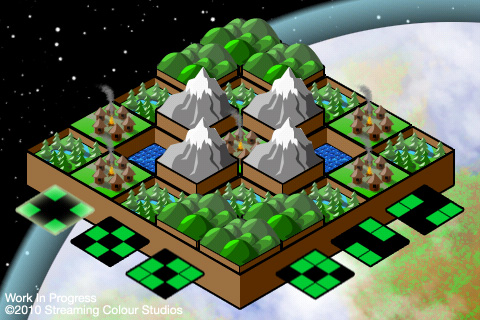
Since my last post about the game, I’ve implemented some pretty major changes to the game. One of which was a complete overhaul of the artwork in the game. I liked the theme of the game, but the artwork seemed a bit dark and drab, so I’ve worked to brighten things up and make the game more appealing and enjoyable to play.

For comparison, this is the last screenshot I posted of the game back at the end of February:
Here’s a screenshot of the current state of the game:
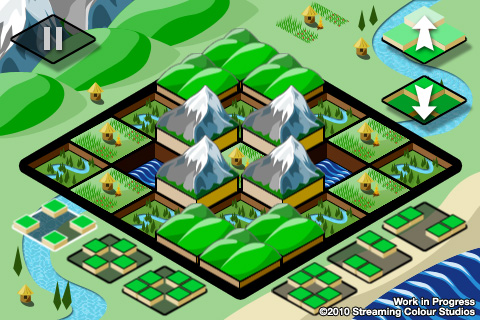
As you can see, the game is basically the same as it was, but I think it looks a lot better. I hope you agree.

One of the other big things I managed to get working was the level editor and level sharing code. When the game ships, it will ship with a bunch of built-in levels. However, it will also contain a level editor so that you create your own levels. Not only that, but you can email levels to your friends so that you can play each others’ levels! This feature was a little more work than I had originally planned for, but I think it adds a lot of fun to the game, so it was worth it. It should allow you to keep playing LandFormer long after you’ve solved all the built-in levels.

Several people have asked for more details about how the game is played. I think it’s easiest if I create a short video showing the game in action, but that will have to wait for a few days. Hopefully I can find some time to do that soon.

Until then, please know that I’m working as fast as I can to get the game done and into your hands. I’m working hard to make sure it’s the best game it can be.

Owen


My First GDC

GDC at Night

I returned home from the Game Developers Conference (GDC) nearly a week ago, but I feel like it has taken me this long to be able to recover from the late nights, the jetlag, the cold I caught, and put things into perspective. I thought I’d share a summary of my experience there, for those who are thinking of maybe going next year.

Executive Summary: SO AWESOME!!!

GDC is held every year in San Francisco. I’ve been in the games industry for over 6 years now, but this was my first time at the conference, so I wasn’t really sure what to expect. I managed to get an All Access Pass to the conference, so I was there for the summits and tutorials, as well as the main conference.

Let me back up a little and talk about my reasoning for going, as that will help you understand why the conference was so valuable to me. At the beginning of the year I started thinking about what conferences I wanted to attend. 360iDev was a must-attend for me, so I booked that first. However, I was torn between attending WWDC (Apple’s big annual conference) or GDC. I attended WWDC last year and it was great. But this year I felt like what I really needed was general game design inspiration, and less Apple-specific technical inspiration. With that in mind, I chose GDC. My goal for the conference was to focus mainly on game design sessions and take in a few technical and business sessions.

So, I arrived in San Francisco Monday, March 8th, the day before the Summits started. I managed to meet up with a bunch of iPhone devs I know from Toronto, other conferences, or Twitter. We had a few beers and tried to adjust to west coast time. It was a good way to ease myself into the week.

Tuesday and Wednesday were the Summit & Tutorial days at GDC. There were two summits I was interested in: the iPhone Summit, and the Independent Games Summit (IGS). I think I spent about 60% of my time at the IGS and about 40% at the iPhone Summit. I saw some great technical iPhone talks by Noel Llopis from SnappyTouch and Phil Hassey from Galcon. I also saw some great IGS talks that ranged in topic from managing an independent game studio’s creative process, to how to better design indie games. I saw a session by Ron Carmel from 2D Boy, several awesome sessions by the people at thatgamecompany (Flower is one of my favourite games), and a terrific session by Randy Smith from Tiger Style (among so many others!). By the end of the Summits, my head was already spinning with inspiration. The IGS design talks in particular were extremely motivating for me. Getting a chance to meet and hear amazing indie game designers/developers talk about their processes was fantastic. It started me thinking about a lot of things as they relate to my own processes. More on that later…

GDC Expo

A tiny segment of the massive GDC Expo

IGF Awards

The IGF Awards

Thursday through Saturday were the main conference, expo, and Independent Games Festival Awards. I sat in session after amazing session listening to industry leaders in game design, technical development, and business talk about their processes. I saw Peter Molyneux talk, Sid Meier talk, and even Will Wright talk. I saw a moving and inspirational talk by Brenda Brathwaite on her exploration into board games with serious themes. I saw a head-ache inducing (in a good way!) talk on PixelJunk Shooter’s real-time fluid dynamics system that made me really miss doing PS3 SPU programming. I saw an in-depth and honest look a the successes and problems encountered by Naughty Dog’s attempts to create an active cinematic experience for Uncharted 2. I was blown away by the quality of the content, and I was left reeling by how the talks started forcing me to think about the direction I want to take with my own games.

Crowds!

There were huge crowds in the halls between sessions!

But of course, the sessions are only part of GDC. The other part comes from meetings and parties. I was able to set up a few meetings with iPhone press to show them my new game. That was really great to be able to demo the game in person. I think it was extremely valuable. Then each night there were countless parties happening. Each party was a great chance to meet people in person who I’ve only communicated with on twitter or via email. It was a chance to discuss iPhone development with other people going through the same thing as me. It was a chance to discuss game design in general with other game designers and developers. It was a chance to have fun with people who share in the same daily challenges that I do.

Will Wright

Will Wright giving his presentation!

For me, I got out of GDC exactly what I wanted: design inspiration, new friends, new business connections and a wealth of knowledge. But perhaps most importantly, GDC helped me to put me back on track with where I want to take my games. When I decided to go indie in 2008, it was because I wanted to make the games that I was compelled to make. What I’ve noticed is that I’ve been making more and more design decisions lately based on what I think will sell well. This isn’t how I want to make games. I want to make the games that I have to make, not that I think I should make because I think it might make some money, even though the idea doesn’t excite me. Granted, I would love to be able to make the games that I feel compelled to make and have them also become a financial success. And obviously I can’t ignore the fact that I’m running a business. But GDC helped to remind me of what I want my priorities to be, and that, to me, is the most important part of having gone.

Owen